

The Philosophy Behind The Menu At Harbor House Inn
Updated: Jun 29
We’ve noticed a pattern over the years that says a lot about how people think about fine dining before they arrive.
When guests book a table at the Harbor House Inn, the first thing they try to understand is the food. Not the coastline. Not the pace of the evening. Not the environment they will be sitting in. It is the Harbor House Inn menu they search for first.
We get emails asking if a specific dish will return. We get messages comparing photos from past visits. Some guests plan entire trips around something they once had here.
And we always end up saying the same thing in different ways.
It will not be the same.
That is not a limitation. It is the foundation of how we work under Chef Matthew Kammerer.
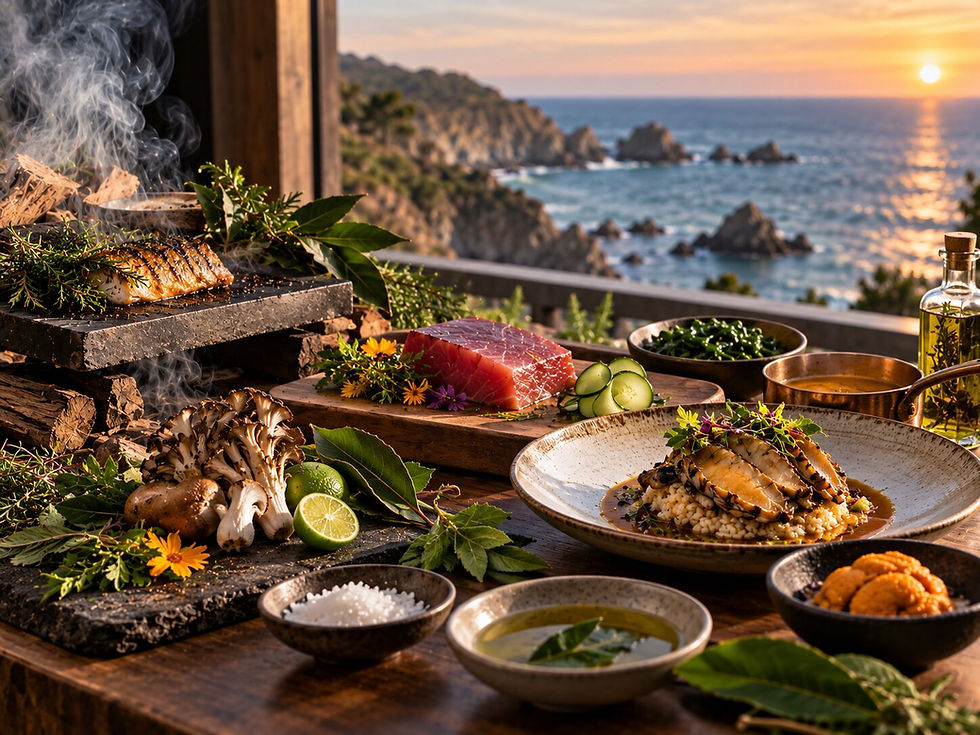
The Harbor House Inn menu does not begin with dishes. It begins with ingredients, and those ingredients come from a very specific place at a very specific moment along the Mendocino Coast.
We’ve learned over time that once guests understand that, the question changes. It shifts from “what will I eat” to “what is happening here today.”
That shift changes everything about how the evening is experienced.
Key Takeaways
The Harbor House Inn menu changes daily based on real conditions along the coast.
Chef Matthew Kammerer builds each service around available ingredients, not fixed dishes.
The seasonal tasting menu reflects forests, tidepools, farms, and the Pacific Ocean.n
Sustainability is practiced daily through sourcing and decision-making, not treated as branding.
Every visit reflects a specific moment in the Mendocino Coast environment
What Actually Shapes The Harbor House Inn Menu Each Day
People often imagine that a kitchen like ours starts with creativity first. A dish idea. A concept. A direction.
That is not how it works here.
We start with what is real in front of us.
What arrived today? What is at its peak? What no longer carries the quality we expect. These are the questions that define the direction of the Harbor House Inn menu.
We’ve seen ingredients arrive looking perfect in the morning and lose character by evening service. We’ve also seen unexpected harvests completely change the shape of a day.
There is no fixed plan holding everything in place. Instead, there is constant evaluation.
Seasonality plays a role, but not in the simplified way people often imagine. Seasons overlap here. Conditions shift quickly along the Mendocino Coast. A harvest can arrive early or late depending on the weather patterns that week.
Because of that, the seasonal tasting menu is not designed ahead of time in a rigid way. It forms through observation.
We’ve learned not to resist that unpredictability. We work inside it.
Why The Menu Changes Every Single Day
We often hear guests ask why the Harbor House Inn menu does not stay consistent for longer periods. It is a fair question, especially for people used to traditional fine dining.
The answer is not philosophical at first. It is practical.
Ingredients do not behave consistently enough to support repetition.
Seasonal Availability
There are weeks when something is abundant and expressive. Then there are weeks when it disappears or changes character completely.
We’ve had guests return expecting a specific element they loved months earlier, only to find it no longer fits the season.
That is not something we correct. It is something we follow.
Weather And Ocean Conditions
The Pacific Ocean influences far more than seafood. It affects temperature, humidity, and even how inland ingredients develop.
We’ve seen storms shift what is available within days. That kind of change directly impacts the seasonal tasting menu in ways you cannot plan around months in advance.
Harvest Cycles
We rely on farms and foragers across the region. Their cycles are not synchronized. One may have abundance while another has none.
We adjust daily based on what actually arrives, not what was expected.
Ingredient Quality
This is the final decision point.
If something does not meet our standard that day, it does not appear on the Harbor House Inn menu, no matter how well it worked before.
We’ve learned that consistency built on compromise is not consistency worth keeping.
How Chef Matthew Kammerer Builds The Menu
Chef Matthew Kammerer works from a very simple starting point.
Ingredients arrive. Then attention begins.
Not toward what they can become in theory, but what they are expressing in that exact moment.
We’ve noticed that ingredients carry subtle differences depending on when and how they are harvested. Even the same product behaves differently depending on the coastal conditions that week.
So instead of forcing structure, the structure forms around the ingredients.
Some dishes exist only briefly. Others evolve slowly over time. Nothing is protected just for repetition.
That approach is what defines the seasonal tasting menu more than any written plan.
The Mendocino Coast Does Not Influence The Menu. It Defines It
At the Mendocino Coast, the environment is not a backdrop. It is active and constantly shifting.
We’ve had mornings where fog delays harvesting. Days where wind changes what can be safely gathered. Weeks where conditions completely reshape availability.
The Harbor House Inn restaurant does not operate outside of those conditions. It operates inside them.
Pacific Ocean Influence
The Pacific Ocean is present in more ways than people expect.
It shapes climate, moisture, and growth patterns inland. Even ingredients harvested miles away carry indirect influence from ocean conditions.
Guests often associate the ocean with seafood courses, but its impact runs through the entire seasonal tasting menu.
Forest And Inland Ingredients
The surrounding forests contribute depth and contrast.
We’ve served courses where guests expected coastal flavors but found something grounded, earthy, and shaped by woodland conditions instead.
Those contrasts are not designed. They are discovered.
Farms And Regional Producers
Agricultural partners across Northern California provide structure and rhythm.
These relationships are long-term. They evolve with the land rather than trends.
Together, they form what we think of as forest-to-coast ingredients, even if that phrase only begins to describe the complexity involved.
What Place-Driven Cuisine Means In Practice
We hear “place-driven cuisine” used often in hospitality.
For us, it has a very direct meaning.
It means the food cannot exist somewhere else without losing something essential.
We’ve worked in other regions. We understand how cuisine changes when it is moved or standardized. Something always becomes less specific.
Here, specificity is the foundation.
The Harbor House Inn menu reflects a narrow geography where forest, coast, and agriculture overlap constantly.
Guests sometimes arrive expecting a typical interpretation of coastal cuisine in California. What they experience instead is something less predictable and more connected to the environment.
Sustainability As A Daily Operating Reality
Sustainability here is not a statement. It is a set of decisions repeated every day.
We work with energy systems like Sonoma Clean Power, evaluate sourcing distances, and constantly adjust to reduce waste without compromising quality.
Recognition, such as Michelin Green Star, exists in the background, but it is not what drives decisions.
What drives decisions is practicality.
If something is not aligned with environmental conditions, it does not make sense for the Harbor House Inn menu.
We’ve learned that sustainability only matters in the kitchen if it supports real cooking decisions. Otherwise, it becomes decoration.
Why There Are No Signature Dishes
We are often asked which dish defines us.
The honest answer is that nothing does for long.
Signature dishes depend on repetition. But repetition requires stability, and stability is not how ingredients behave here.
We’ve seen dishes disappear simply because the ingredient that defined them changed too much with the season.
That is not a loss. It is movement.
Guests sometimes return expecting something familiar. What they find instead is something aligned with the current conditions of the seasonal tasting menu.
Over time, many of them come to prefer that uncertainty.
What Guests Actually Remember From The Experience
We’ve read thousands of reflections from guests over the years, and something consistent appears.
People rarely remember dishes in isolation.
They remember moments.
A shift in light during a course. Fog outside the window. A conversation during service. A feeling of timing that aligns with the coast outside.
We’ve had guests return years later and remember exactly where they were sitting, but not every detail of what they ate.
That tells us something important about how memory forms in this environment.
The Harbor House Inn menu is part of the experience, but not the only part.
Why The Experience Never Repeats
No two visits feel the same because no two days along the Mendocino Coast are the same.
Weather changes. Harvests change. Ingredients change. Even internal rhythms shift with time.
We continue to see guests arrive expecting repetition and leave talking about difference.
At some point, that expectation shifts.
Instead of asking what will be the same, they start asking what will be different.
That is usually when they understand how the Harbor House Inn menu actually works.
How Returning Guests Learn To Experience The Menu Differently
There’s also something we’ve noticed specifically with returning guests from the wider Northern California dining circuit. People who are used to structured Michelin dining experience formats often arrive expecting precision in repetition. The first visit feels unfamiliar in that sense. But by the second or third visit, something shifts. They stop trying to track the Harbor House Inn menu as a sequence of dishes and start paying attention to how each course responds to the season itself.
We’ve had guests tell us they remember the smell of wet coastal air more clearly than anything they ate. Others recall the sound of the wind hitting the glass more vividly than the final course. That’s not something we design. It’s something that happens when food, place, and timing are not separated from each other.
Over time, that becomes the quiet identity of the seasonal tasting menu. Not consistency, but awareness. Not repetition, but presence. And for many guests, that is what makes the experience difficult to compare with anything else along the Mendocino Coast.
That is usually where their understanding settles, even if they can’t immediately put it into words.
Conclusion
We’ve hosted guests who planned their entire trip around a single meal. Others arrived curious about the coastline itself. Some came because they had heard about the philosophy behind the food rather than the food itself.
But the guests who return often come back for something less tangible.
Not a dish. Not a fixed memory. Not a menu they can predict.
At the Harbor House Inn, under Chef Matthew Kammerer, the Harbor House Inn menu continues to shift with the Mendocino Coast, shaped by forests, tides, farms, and the Pacific Ocean.
And long after the meal ends, what most guests remember is not what stayed the same. You’re in for something new every time!



Comments