

What Is a Luxury Tasting Menu Experience Really Like?
Updated: Jul 20
A luxury tasting menu, at its best, isn’t just dinner with more courses. It’s a luxury tasting menu experience shaped by timing, mood, service, and place, where each plate arrives as part of a larger story rather than a standalone order. That’s why more travelers now build trips around a true tasting menu experience instead of a conventional reservation.
At a great Michelin tasting menu, the meal reflects the chef’s point of view, the season outside, and the setting around you. At Harbor House Inn, that idea feels especially clear. Set on the Mendocino Coast, this historic luxury inn pairs a Two Michelin Stars restaurant with sustainable hospitality, quiet attention, and a sense of place that stays with you long after the last course.
Key Takeaways
A luxury tasting menu is a chef-curated, multi-course dining experience.
Every course is designed to reflect seasonality, technique, and storytelling.
Michelin tasting menus focus on precision, hospitality, and consistency.
Harbor House Inn combines Two Michelin Stars, a Michelin Green Star, and a Michelin Key.
Staying overnight transforms dinner into a complete destination experience.
What Is a Luxury Tasting Menu?
A luxury tasting menu is a chef-curated multi-course dining experience where each course is intentionally designed to create a complete culinary journey. Unlike traditional à la carte dining, every dish is served in a deliberate sequence that reflects the chef's philosophy, seasonal ingredients, and the unique character of the destination.
Unlike à la carte dining, where guests build their own meal from individual selections, a multi-course tasting menu is meant to be experienced from start to finish as one complete composition. The pacing matters, the order matters, even the shifts in mood matter. You’re not choosing disconnected dishes. You’re saying yes to the chef’s full point of view.
That’s a big part of the appeal in a fine dining experience. A luxury tasting menu gives structure to the evening, but it also leaves room for surprise. Courses tend to move with the season, growing brighter, deeper, lighter, or more reflective depending on the time of year and the ingredients available at that moment.
In a Michelin restaurant, that intention is usually even more pronounced. Service is highly tuned, the progression is deliberate, and the meal often feels closer to a story unfolding than a standard dinner. That’s what separates a Michelin tasting menu from a nice restaurant meal. It asks you to slow down. And if you let it, it can change the whole rhythm of the night.
Luxury Tasting Menu | À La Carte Dining |
Chef-curated experience | Guest chooses dishes |
Multi-course progression | Individual courses |
Seasonal menu | Fixed selections |
Storytelling through food | Independent dishes |
Timed service | Flexible pacing |
Complete culinary experience | Traditional dining |
Why Do Michelin Restaurants Serve Tasting Menus?
Many Michelin-recognized restaurants choose tasting menus because they allow chefs to present their culinary philosophy exactly as intended. Rather than selecting individual dishes, guests experience a carefully planned progression of flavors, textures, and techniques that showcase seasonal ingredients and the kitchen's creativity.
Every Course Reflects the Season and the Landscape
One of the defining characteristics of a luxury tasting menu is that it changes throughout the year. Rather than repeating the same dishes, many Michelin restaurants build menus around what is naturally available each season, allowing every visit to feel unique.
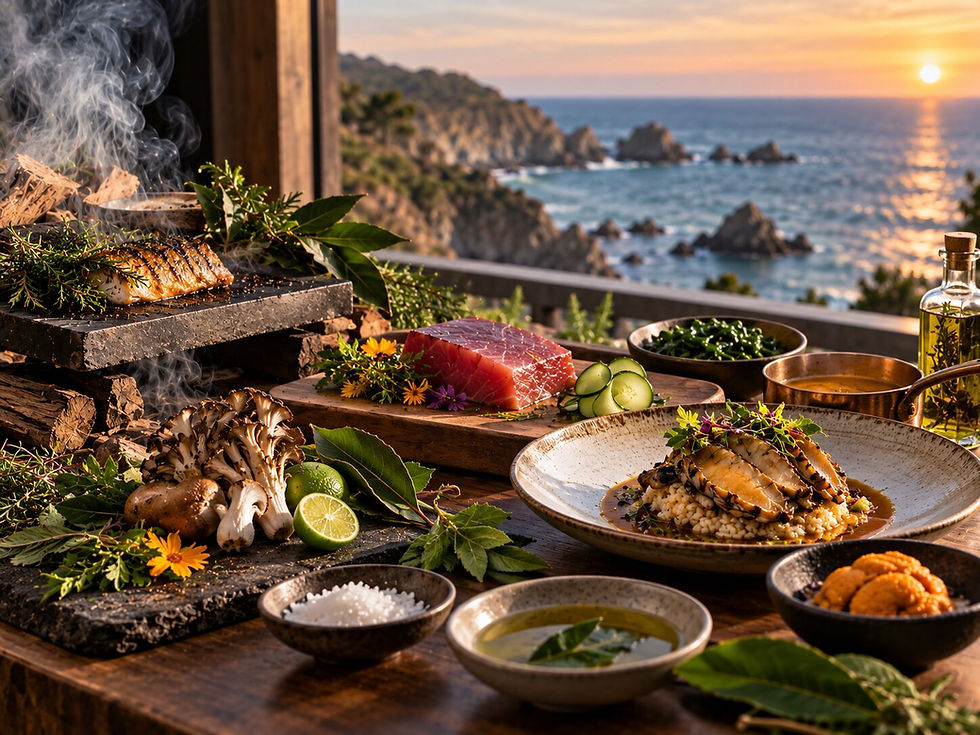
This is ingredient-driven cuisine in a place where the Pacific Ocean, nearby forests, rocky tidepools, and the Harbor House Inn Ranch all shape what’s possible. The result is hyper-local cuisine rooted in the Mendocino Coast itself, not in a fixed set of signatures repeated year-round for convenience.
That’s what makes a seasonal tasting menu feel alive. Seasonal ingredients arrive with their own timing, and the kitchen responds to that timing instead of forcing a static idea onto the plate. Some weeks, the emphasis may feel more ocean-driven. At other moments, the pull of the ranch or the surrounding Northern California coast becomes more noticeable. Either way, the meal reflects what the region naturally gives.
There’s restraint in that approach. Also honesty.
In a luxury dining experience, especially one connected to sustainable gastronomy, the most memorable part often isn’t excess. It’s closeness to place. On the Mendocino Coast, that means the menu speaks quietly but clearly about weather, water, soil, and season without ever needing to say so out loud.
What are the best hotel restaurants for fine dining?
Exceptional hotel restaurants stand apart when the food, service, setting, and stay all feel tied together, so the meal isn’t separate from the property but part of the entire visit. At Harbor House Inn, that idea comes into focus in a very personal way.
Harbor House Inn offers one of California's rare combinations of culinary and hospitality recognition. The property has earned Two Michelin Stars for its restaurant, a Michelin Green Star for sustainability, and a Michelin Key recognizing its exceptional accommodations. Together, these distinctions create a destination where the stay is as memorable as the meal.
Chef Matthew Kammerer leads a luxury tasting menu centered on hyper-local cuisine, with ingredients shaped by the coast and by Harbor House Inn Ranch. That connection gives the dining room real depth, but it’s the personalized hospitality that completes the experience. Staying overnight means the tasting menu becomes part of a larger rhythm: arriving in ocean air, settling into the inn, dining at an unhurried pace, and waking up still inside the same mood. That’s destination dining in its most natural form, and it’s a big reason Harbor House Inn feels like a true luxury coastal retreat on the Mendocino Coast.
What Makes a Luxury Tasting Menu Worth the Price?
A luxury tasting menu reflects far more than the ingredients on the plate. Guests experience months of menu development, technical precision, personalized hospitality, carefully selected wine pairings, premium seasonal ingredients, and attentive service that unfolds over several hours. For many travelers, the value lies in the complete experience rather than the number of courses.
Luxury Is Found in the Details, Not Excess
A lot of people still picture luxury dining as silver domes, hushed stiffness, and a room trying a little too hard to impress. That version exists. It’s just not the most interesting one anymore.
Modern luxury usually feels quieter. In an intimate dining room, the tone is set by ease, not flash. Service moves at the right pace, never rushed and never dragging, and small details start to matter more than obvious displays of extravagance. A chair placed just so. A warm greeting that sounds personal instead of rehearsed. The sense that someone noticed your preferences without turning it into theater.
That’s where a real fine dining experience earns its place. Thoughtful presentation matters, yes, but so does the space between courses, the cadence of the evening, and the feeling that the staff is fully present. Personalized hospitality isn’t about overexplaining every moment or hovering near the table. Sometimes it’s the opposite. Knowing when to step in, when to pause, and when to let the room breathe.
Quiet luxury has become such a talking point in travel because people are tired of performance. Fair enough. A memorable tasting menu experience tends to feel more intimate than showy, more considered than loud, and far more lasting because of it.
The Story Behind the Experience
Chef Matthew Kammerer’s work is often described through ingredients, but the deeper story is really about attention. Attention to place. Attention to sourcing. Attention to what the Mendocino Coast can honestly offer without pretending to be somewhere else.
That philosophy shapes Harbor House Inn in ways guests can feel, even if they never hear it spelled out. Hyper-local cuisine isn’t a marketing line here. It’s a commitment to responsible sourcing, seasonal ingredients, and respect for the coast that surrounds the property. The Harbor House Inn Ranch plays a role in that, as does the wider region, where the meeting of ocean, forest, and climate gives the restaurant a very distinct identity.
There’s also a strong thread of sustainability running through the experience, which helps explain the Michelin Green Star. Sustainable gastronomy, at least the version that feels real, isn’t about self-congratulation. It’s about making choices that honor the place feeding the restaurant in the first place.
And that’s the heart of ingredient-driven cooking. Not technical bravado for its own sake. Not novelty at any cost. Just a serious, thoughtful effort to let the Mendocino Coast speak in its own accent.
Why a Tasting Menu Is More Than Dinner
People now travel for meals in the same way they travel for architecture, wine regions, or national parks. Maybe more than ever. A Michelin dining reservation can become the anchor for an entire weekend, especially in places known for destination dining.
A luxury tasting menu experience offers something many travelers want but can’t always name: focus. For two or three hours, the outside noise drops away. Your attention narrows. The room, the service, the sequence of courses, and the setting begin to work together, and dinner becomes part of how you remember the trip itself.
That’s why culinary tourism keeps growing, especially in California. Travelers aren’t only looking for a restaurant with prestige. They’re looking for a sense of place, something they couldn’t have had in Los Angeles, Chicago, or Manhattan because it belongs specifically to one stretch of coast, one chef, one season, one night.
A multi-course tasting menu can create that emotional connection almost by stealth. You arrive expecting dinner. You leave with a memory attached to weather, conversation, and the feeling of having been somewhere singular. That’s more than a meal. It’s one of the reasons fine dining in California continues to draw people north, even to places far from major cities.
Harbor House Inn's Interpretation of Luxury Dining
Harbor House Inn brings together a rare set of qualities that make the whole experience feel complete. The property is a historic luxury inn from 1916, set above the Pacific Ocean on the Mendocino Coast, with only eleven guest rooms and a twenty-seat restaurant. That scale matters. It keeps the atmosphere personal and calm, more boutique luxury inn than grand hotel.
The recognition is notable: Two Michelin Stars, a Michelin Green Star, and a Michelin Key. Yet the feeling isn’t one of ceremony for ceremony’s sake. It’s grounded. Thoughtful. A little understated, in the best possible way.
That balance is what gives Harbor House Inn its identity as a luxury coastal dining destination. The restaurant’s hyper-local cuisine and seasonal tasting menu are tied to the surrounding coast and to the Harbor House Inn Ranch, while the inn itself extends the mood through personalized hospitality and sustainable hospitality practices. Add in the draw of California luxury travel and the rise of culinary tourism, and it’s easy to see why this has become a sought-out address for Michelin dining.
For guests, the result is a luxury tasting menu experience that feels whole. A Michelin restaurant inside a historic setting. Quiet luxury without pretense. A meal shaped by the Pacific Ocean and the Mendocino Coast, then carried into the rest of the stay. Honestly, that’s the part people remember.
Who Is a Luxury Tasting Menu Best For?
A luxury tasting menu experience is ideal for:
Anniversary celebrations
Romantic getaways
Culinary travelers
Michelin dining enthusiasts
Luxury travelers
Food lovers exploring Northern California
Special occasion dining
Destination dining experiences
Conclusion
A luxury tasting menu offers much more than multiple courses. It represents craftsmanship, hospitality, seasonality, and a carefully designed experience that unfolds over the course of an evening. At Harbor House Inn, those qualities are strengthened by Two Michelin Stars, a Michelin Green Star, a Michelin Key, hyper-local cuisine, and the natural beauty of the Mendocino Coast. For travelers seeking one of California's most memorable dining experiences, Harbor House Inn offers the rare opportunity to enjoy world-class cuisine while staying in the very place that makes it possible.
FAQs
What is a luxury tasting menu?
A luxury tasting menu is a chef-led, multi-course meal designed as a full experience rather than a set of separate choices. It usually emphasizes seasonality, pacing, service, and a strong point of view.
What makes a Michelin tasting menu different?
A Michelin tasting menu often stands out for its precision, consistency, hospitality, and sense of identity. In a Michelin restaurant, every part of the evening is carefully considered, from the order of courses to the rhythm of service.
How many courses are in a tasting menu?
There’s no single rule. Some tasting menus run five or six courses, while others stretch much longer. What matters more is the progression and how the meal unfolds over time.
What should I expect during a tasting menu experience?
Expect a slower, more immersive meal with several courses served in sequence. The staff will guide the pace, and the menu will usually reflect the chef’s philosophy, the season, and the setting.
Does Harbor House Inn offer a tasting menu?
Yes. Harbor House Inn offers a luxury tasting menu experience through its Michelin-recognized restaurant on the Mendocino Coast.
Why do tasting menus change with the seasons?
Because the best tasting menus respond to ingredient availability and quality. Seasonal changes allow chefs to reflect what is freshest, most expressive, and most connected to the region at that moment.
What is hyper-local cuisine?
Hyper-local cuisine centers on ingredients sourced as close to the restaurant as possible, often from nearby waters, farms, ranches, and producers. It reflects a very specific place.
Why is Harbor House Inn Michelin recognized?
Harbor House Inn is Michelin recognized for the quality of its cuisine, its commitment to sustainability, and the distinct character of both the restaurant and the property. It holds two Michelin Stars, a Michelin Green Star, and a Michelin Key.
What is the Michelin Green Star?
The Michelin Green Star recognizes restaurants that show a serious commitment to more sustainable practices, including sourcing, environmental awareness, and thoughtful operations.
Where is Harbor House Inn located?
Harbor House Inn is located on the Mendocino Coast in Northern California, overlooking the Pacific Ocean.
How long does a luxury tasting menu usually take?
Most luxury tasting menus last between two and three hours, allowing guests to experience each course at a relaxed pace.
Is a tasting menu worth it?
For travelers who appreciate exceptional cuisine, seasonal ingredients, and personalized hospitality, a tasting menu offers a memorable dining experience that goes beyond a traditional meal.
Can dietary restrictions be accommodated?
Many Michelin restaurants can accommodate dietary restrictions when notified in advance, although accommodations depend on the menu and available ingredients.
Why do people travel for tasting menus?
Many travelers plan trips around Michelin-recognized restaurants because destination dining combines exceptional cuisine with memorable hospitality, local culture, and unique surroundings.



Comments