

What a Two Michelin Star Tasting Menu on the Mendocino Coast Is Actually Like
Updated: Jul 7
It Usually Starts With A Question
One couple arrived nearly an hour early.
They had spent the afternoon driving up Highway 1, stopping every few miles to take photos of the coastline. By the time they checked in, the sun was beginning to drop, and the fog was starting to move across the water.
Before anything else, they asked us a question we hear all the time.
"What about the proportions?"
People booking a two Michelin star tasting menu often know they're in for something different. What they don't always know is what that difference actually feels like.
Many guests arrive with assumptions. Some expect tiny portions and a very serious atmosphere. Others expect a room full of food critics quietly analyzing every bite. The reality is usually much simpler.
Dinner begins. The ocean is outside the window. Conversations settle down. The first course arrives.
From that point forward, most people stop thinking about what they expected.
The Drive To The Coast Is Part Of The Experience
We've noticed something interesting over the years.
Guests rarely walk through the door talking about Michelin stars.
They're usually talking about the drive. A herd of elk they spotted earlier that day. A beach they almost missed. A stretch of coastline where they pulled over just to watch the waves.
That's one reason Mendocino Coast fine dining feels different from dining in a major city.
People arrive in a different frame of mind.
They're not rushing from an office. They aren't squeezing dinner between meetings. Many have spent hours moving through forests, coastal roads, and small towns before reaching us.
The meal begins long before anyone sits at a table.
Settling In
One thing people don't expect is how quickly the room relaxes.
Guests often arrive carrying a little tension.
It's understandable.
The words Michelin, tasting menu, and fine dining can create a certain image. Then the first few minutes pass. Water is poured. The menu is introduced. People realize nobody is testing them.
Nobody expects them to identify every ingredient.
Nobody expects them to know the difference between one culinary technique and another.
A great Michelin restaurant experience shouldn't feel like an exam.
We've welcomed guests celebrating anniversaries, engagements, birthdays, and retirement trips. We've also welcomed people who simply wanted a memorable dinner while traveling through Northern California.
The common thread isn't expertise.
It's curiosity.
The First Few Courses Usually Change Everything
We've watched this happen hundreds of times.
A guest leans forward after the first bite and looks across the table.
Not because they're confused. Because they're surprised. The surprise isn't always about complexity. In fact, it's often the opposite.
Many of our dishes are built around ingredients that don't need much intervention.
Under the direction of Chef Matthew Kammerer, the focus remains on letting exceptional products speak clearly for themselves.
That approach is at the heart of our ingredient-driven cuisine.
Guests frequently expect elaborate presentations and dramatic techniques. Instead, they encounter flavors that feel precise, intentional, and deeply connected to the surrounding landscape.
The reaction is often the same.
People slow down.
The Coast Finds Its Way Onto The Plate
Every restaurant reflects its surroundings in some way.
At our Mendocino Coast restaurant, that connection runs deep.
The ocean isn't simply a view.
It's part of the food.
We've had guests describe the meal as a form of storytelling. Not because someone is explaining every course in detail, but because each dish reveals another piece of the environment around us.
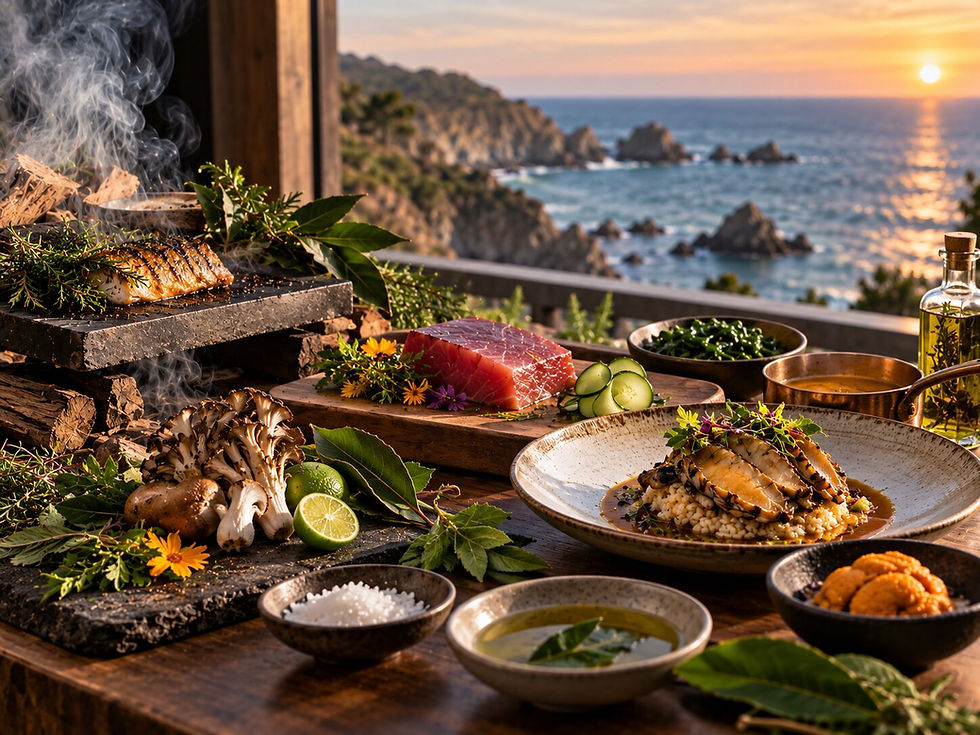
Sea vegetables. Coastal herbs. Products gathered from nearby forests. Ingredients sourced from local waters.
Our ocean-inspired cuisine reflects the place where it's served.
One evening, a guest told us that the meal felt like a guided walk through the coastline without ever leaving the table.
We've remembered that comment for years.
Around The Middle Of Dinner, Something Changes
The first few courses usually generate conversation.
People ask questions. They compare notes. They speculate about ingredients.
Then, somewhere in the middle of the evening, a shift tends to happen.
The room gets quieter. Not silent. Just quieter.
We've noticed that guests become more focused. The outside world fades into the background. People become absorbed in the rhythm of the meal. A surprising number of diners mention this afterward.
They expected remarkable food.
What they didn't expect was how present they would feel.
That's one reason a well-executed Michelin tasting menu experience can leave such a lasting impression.
It's not just about eating.
It's about paying attention.
Why The Menu Doesn't Stay The Same
We often receive calls asking if a specific dish will be available on a future date.
The answer is usually complicated.
Our approach revolves around a seasonal tasting menu.
The ingredients determine the menu rather than the other way around.
We've seen situations where an ingredient is exceptional for a few days and then disappears completely.
Nature doesn't work on a publishing schedule.
That's part of the beauty of it.
Returning guests frequently tell us they enjoy not knowing exactly what they'll encounter.
There is anticipation in that uncertainty.
The philosophy remains consistent.
The details continue to evolve.
The Ingredients Generate More Questions Than Ever
Five years ago, guests rarely asked where vegetables were grown.
Today, we hear that question almost every night.
People are paying closer attention to sourcing than ever before.
As a foraged ingredients restaurant, many of the ingredients featured throughout our menu have a
direct connection to the surrounding environment.
Guests are often fascinated by this.
They want to know where something was found.
How it was harvested.
Why does it taste different from similar ingredients they've tried elsewhere? Some of the longest conversations we have with diners happen after a course featuring something they've never encountered before.
Curiosity tends to create memorable experiences.
What The Michelin Recognition Actually Means
People often ask about the Michelin stars.
It's a reasonable question.
For many guests, the reservation itself started with seeing that recognition.
The easiest way to explain it is this. The stars create expectations. The work happens every day afterward.
Every evening, every ingredient, every service, every decision contributes to the guest experience. That's why consistency matters so much.
As a Michelin guide restaurant, there is an ongoing commitment to maintaining standards that guests may never fully see.
Most of the effort happens behind the scenes.
The dining room only reveals the final result.
Sustainability Has Become Part Of The Conversation
We've noticed another shift in recent years.
Guests increasingly want to understand how restaurants interact with the places around them. That interest has grown steadily.
Being recognized as a Michelin Green Star restaurant often sparks conversations about sourcing, stewardship, and responsibility.
What makes those conversations meaningful is that they happen naturally. People don't ask because they're reading a brochure.
They ask because they can see the connection between the food and the landscape around them.
The closer a meal feels to its environment, the more those questions seem to matter.
Why People Travel So Far For Dinner
Some guests drive a few hours. Others fly across the country. A surprising number build entire vacations around a reservation.
We've welcomed travelers who considered this stop the centerpiece of their trip.
That trend has become increasingly common within Michelin dining in California.
Restaurants have become destinations in their own right.
The Mendocino Coast continues to attract visitors looking for experiences they can't find elsewhere.
For many travelers, that combination of scenery, hospitality, and food has helped establish the region as a respected California culinary destination.
More Than A Luxury Dining Experience
The phrase luxury dining experience gets used frequently.
Sometimes too frequently.
Luxury means different things to different people. For some guests, luxury is having access to extraordinary ingredients. For others, it's having three uninterrupted hours with family or friends.
We've had guests tell us that the greatest luxury wasn't a particular course.
It was being able to slow down.
No meetings. No notifications. No distractions.
Just a meal shared with people they care about.
That perspective has become increasingly common.
Fine Dining On The California Coast Feels Different
We've spoken with guests who regularly dine at acclaimed restaurants in major cities around the world.
Many tell us the atmosphere here feels different.
Part of that comes from the setting.
Part comes from the pace.
There's something unique about experiencing fine dining on the California coast while waves break just beyond the dining room.
The environment changes the way people engage with the meal.
Even guests who arrive focused primarily on food often leave talking about the coastline.
The two become difficult to separate.
The Last Course Rarely Ends The Conversation
One thing we've learned after years of hospitality is that people don't always remember every dish.
They think they will, while most don't.
What they remember are moments. A particular view from the window. A conversation they had between courses.
The smell of the ocean when they stepped outside afterward.
We've had guests return years later and describe exactly where they were sitting.
Some remember the weather. Others remember a course that sparked a discussion lasting the entire drive home.
That's what makes a great Michelin dining experience memorable.
The food matters. Of course it does. But memory doesn't work like a menu. People remember feelings first.
Looking Back On The Evening
As a Michelin restaurant Mendocino Coast travelers seek out from around the world, we have the opportunity to witness countless celebrations.
Anniversaries, engagements, birthdays, reunions, and sometimes no occasion at all. Just dinner.
Years later, some guests come back and request the same table they sat at during their first visit to Harbor House Inn.
They rarely remember every one of the tasting menu courses.
They don't always remember the exact sequence of the meal.
What stays with them are memories of an evening immersed in the coastline, enjoying the coastal tasting menu, which has been thoroughly thought out, and a level of hospitality so wonderful it made them forget the rest of the world for a moment.
That's the part people carry home with them.
And it's the reason so many guests continue seeking out Northern California fine dining, a memorable Michelin star dinner experience, and the distinctive perspective on Michelin dining in California that has made Harbor House Inn a destination for those looking for something more than simply dinner.
FAQs
What is a Two-Michelin-Star tasting menu?
A Two-Michelin-Star tasting menu is a multi-course dining experience served at a restaurant awarded two stars in the MICHELIN Guide. At Harbor House Inn on the Mendocino Coast, it's a seasonal tasting menu where the sequence of courses is already decided and built around the best ingredients available at that moment. Rather than the tiny portions and formal, intimidating atmosphere many guests expect, the experience is precise, ingredient-driven, and unhurried, with the Pacific just beyond the dining room window.
What makes Harbor House Inn different from other Michelin restaurants?
Harbor House Inn stands apart because the Mendocino coastline becomes part of the food itself, not just the view. Under Chef Matthew Kammerer, the kitchen builds dishes around sea vegetables, coastal herbs, ingredients foraged from nearby forests, and products from local waters an ingredient driven, ocean-inspired cuisine rooted in its exact location. Guests often describe the meal as a guided walk through the coastline without leaving the table. Combined with the remote setting and the drive up Highway 1, it's an experience a metropolitan Michelin restaurant can't replicate.
What ingredients are commonly featured on a Mendocino Coast tasting menu?
A Mendocino Coast tasting menu at Harbor House Inn commonly features sea vegetables, coastal herbs, ingredients gathered from nearby forests, and products sourced from local waters. As a foraging-focused restaurant, much of what appears on the menu has a direct connection to the surrounding environment. The kitchen favors letting exceptional local products speak for themselves rather than relying on elaborate techniques, so the flavors feel precise, intentional, and tied to the landscape. Because sourcing is seasonal, the specific ingredients change throughout the year.
Why do Michelin restaurants focus on seasonal ingredients?
Michelin restaurants focus on seasonal ingredients because produce tastes best when it's used at its peak, and seasonality keeps the cooking connected to its surroundings. At Harbor House Inn, the ingredients determine the menu rather than the other way around an ingredient may be exceptional for just a few days before it disappears, since nature doesn't follow a publishing schedule. This is why we can't always promise a specific dish on a future date, and it's part of what returning guests enjoy: the anticipation of not knowing exactly what they'll encounter.
What is a Michelin Green Star restaurant?
A MICHELIN Green Star is a distinction the MICHELIN Guide awards to restaurants recognized for their commitment to sustainability, sourcing, and environmental stewardship. Harbor House Inn holds a MICHELIN Green Star alongside its Two MICHELIN Stars. For us, the recognition reflects an approach guests can see for themselves in the close connection between the food and the surrounding Mendocino landscape a link that tends to spark conversations about sourcing and responsibility naturally, rather than from a brochure.
How does sustainability influence the dining experience?
Sustainability shapes the dining experience at Harbor House Inn through sourcing that stays closely tied to the surrounding environment, much of it foraged or drawn from local waters and nearby forests. Guests increasingly want to understand how a restaurant interacts with the place around it, and here those conversations happen naturally people ask because they can see the connection between the food and the landscape on the plate. As a MICHELIN Green Star restaurant, that relationship between meal and environment is central to the evening rather than an add-on.
Is Harbor House Inn suitable for special occasions?
Yes, Harbor House Inn is a sought-after destination for special occasions on the Mendocino Coast. Over the years we've welcomed guests celebrating anniversaries, engagements, birthdays, retirements, and reunions, as well as travelers who simply wanted a memorable dinner and many build an entire trip around the reservation. The combination of scenery, hospitality, and a seasonal tasting menu creates an evening guests remember years later; some return and ask for the very same table from their first visit.
What should guests know before booking?
Before booking a Two-Michelin-Star tasting menu at Harbor House Inn, guests should know the menu is seasonal and ever-changing, so specific dishes can't be guaranteed, as the ingredients change each evening. It helps to arrive without rushing: the drive up Highway 1 is part of the experience, and the meal is meant to be enjoyed over several unhurried hours. No special expertise is needed; curiosity matters more than knowing every ingredient or technique. Reservations are required, and you can book through OpenTable or contact us directly at (707) 877-3203.
Are there any specific recipes that are considered Michelin-style?
There are no specific recipes that define Michelin-style cooking. Instead, Michelin-recognized dining is characterized by exceptional ingredients, refined techniques, creativity, consistency, and thoughtful presentation, with each chef bringing their own unique culinary approach.



Comments