

Fine Dining Mushroom Recipes Inspired by Michelin-Starred Cuisine
Updated: Sep 1
Mushrooms have a way of making a dish feel deeper without demanding much attention. A well-cooked maitake can be crisp around the edges and almost delicate inside. A trumpet mushroom brings a meaty texture to the plate. Then there are varieties such as candy cap, which can take a dish in a completely different direction when used in a dessert.
That range is one reason mushrooms have found a natural place in contemporary fine dining.
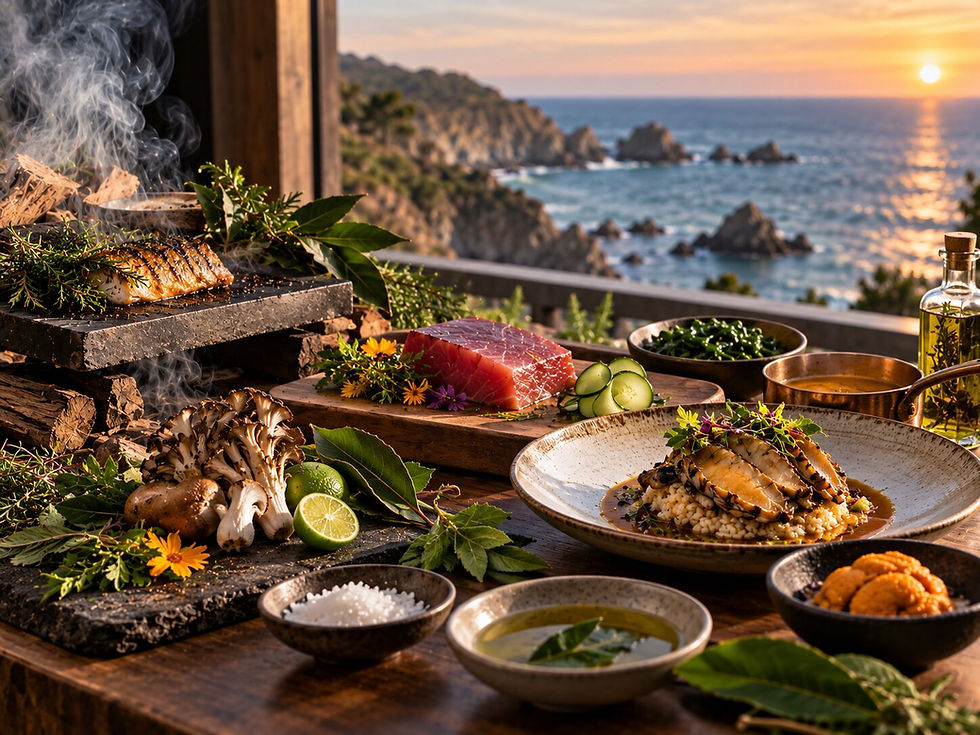
At Harbor House Inn on California's Mendocino Coast, mushrooms appear within a much larger culinary philosophy. The restaurant works closely with the landscape around it, using ingredients from nearby farms, forests, gardens, and the coastline. Its menus change with the seasons, so a particular mushroom may appear in one preparation and disappear when the next season brings different ingredients.
For anyone interested in fine dining at home, these dishes offer useful ideas without requiring a restaurant kitchen.
Why Do Mushrooms Work So Well in Fine Dining?
There is more to a mushroom than its earthy flavor.
Different varieties have noticeably different textures. Maitake has delicate, ruffled edges that respond well to high heat. Trumpet mushrooms have a dense stem that can be sliced, seared, or roasted. Candy cap mushrooms have an aromatic quality that makes them interesting beyond savory cooking.
That gives a chef plenty of room to work.
A mushroom might be fried until crisp and used as a contrast to a soft ingredient. It might be cooked slowly and served with a sauce. It can be incorporated into a broth, used to add depth to another ingredient, or, with the right variety, become part of a dessert.
The most interesting preparations do not necessarily involve the greatest number of ingredients. Often, the mushroom is given enough room for its own character to come through.
Maitake Mushroom With a Coastal Twist
Maitake is one of the mushrooms that appears in Harbor House Inn's culinary repertoire.
One sample menu pairs fried and infused maitake mushroom with purple sea urchin. It is an unusual combination at first glance. One ingredient comes from the forest, the other from the Pacific, yet they make sense together within the restaurant's coastal cooking.
The preparation also reflects an important part of the Harbor House approach: ingredients from the land and sea do not have to be treated as separate categories.
The restaurant has also featured tempura maitake mushroom with lace lichen and nori broth. Here, the crisp texture of the mushroom meets ingredients associated with the coastal environment.
For a home cook, the lesson is fairly simple. Start with a mushroom that has a strong texture, cook it with enough heat to develop some crispness, and then look for an ingredient that brings contrast rather than competing with it.
A light broth, a little acidity, seaweed, or a savory infusion can be enough.
Trumpet Mushrooms and the Richness of Poultry
Trumpet mushrooms offer a completely different experience.
Their firm texture makes them particularly useful alongside richer ingredients. At Harbor House Inn, Devil's Gulch squab is paired with trumpet mushrooms in a sample tasting menu.
The pairing works on a basic culinary principle: the mushroom brings an earthy quality and substantial bite, while the poultry provides richness.
You do not need to turn the mushroom into something unrecognizable. In fact, keeping its texture intact can be the more interesting choice.
A trumpet mushroom can be cut lengthwise, browned in a pan, and finished with butter or a concentrated sauce. The browned surface adds another layer of flavor while the interior remains tender.
For a more composed plate, the mushroom could sit alongside roasted poultry, a vegetable puree, and a small amount of jus. The portions do not need to be large. In tasting-menu cooking, a few well-prepared bites can carry more impact than a crowded plate.
Candy Cap Mushrooms Show That Mushrooms Are Not Just Savory
Perhaps the most surprising mushroom preparation at Harbor House Inn is found in the dessert course.
The restaurant has featured a candy cap mushroom macaron.
This is a useful example of how fine dining can challenge familiar ideas about ingredients. Most people naturally associate mushrooms with butter, garlic, broth, meat, or vegetables. Candy cap mushrooms can move into another part of the menu entirely.
Their aroma can work with sweet flavors, making them suitable for carefully balanced desserts.
A candy cap preparation could be paired with ingredients such as caramel, chocolate, fruit, nuts, or cream. The goal is not necessarily to make a dessert taste strongly of mushrooms. Instead, the mushroom can provide an underlying aromatic note that makes the finished dish harder to immediately identify.
That element of surprise is often what makes an ingredient memorable.
What Can You Make With Maitake Mushrooms at Home?
A fine dining approach does not mean a recipe has to be complicated.
For maitake, one of the simplest starting points is high-heat cooking.
Break the mushroom into small clusters while keeping enough of the structure intact. Cook it in a hot pan until the edges become browned and crisp. A little butter can be added toward the end, along with herbs or another aromatic ingredient.
From there, the dish can go in several directions.
A crisp maitake cluster could sit over a smooth vegetable puree. It could be served with a light broth. It could become a garnish for roasted fish. Or it could be paired with a seaweed-based component for a coastal flavor profile.
The important part is texture. Maitake already has an interesting structure, so the cooking method should take advantage of it rather than flattening it.
How Do Fine Dining Chefs Use Mushrooms in Sauces and Broths?
Sometimes the mushroom does not need to be the centerpiece.
Mushrooms can provide depth to stocks, broths, and sauces. At Harbor House Inn, mushrooms are among the ingredients that can be used in stocks and sauces within the tasting menu.
This is especially useful when building a dish around another primary ingredient.
Imagine a piece of fish served with a light mushroom broth. The fish remains the focus, while the broth adds another layer underneath it.
The same principle can work with poultry, vegetables, grains, and pasta.
For home cooking, a mushroom broth can be made with fresh mushrooms, aromatics, and water or stock. The liquid can then be reduced until its flavor becomes more concentrated. A small amount around the finished dish can be more effective than covering the plate with sauce.
Fire, Steam, and Smoke Change the Character of Mushrooms
Cooking technique matters as much as the ingredient itself.
Harbor House Inn's restaurant focuses on natural sources of heat, particularly fire and steam, and also uses smoke in its cooking.
Mushrooms respond especially well to these techniques.
Fire can give the surface a browned, almost roasted character. Steam preserves moisture and works well when the goal is a softer texture. Smoke can introduce another aromatic layer, particularly when paired with ingredients that already have earthy or savory qualities.
There is no single correct method.
A delicate mushroom may benefit from gentle cooking, while a sturdy maitake or trumpet mushroom can handle more direct heat. The right question is not simply, “How should I cook this mushroom?” It is, “What does this particular mushroom already offer, and which technique will bring that out?”
Mushrooms and the Mendocino Coast
The setting of Harbor House Inn makes mushrooms part of a much larger story.
The restaurant sits along the Mendocino Coast, where the culinary program draws inspiration from both the Pacific and the inland landscape. Chef Matthew Kammerer and his team forage along the coast and work with produce grown through the property's agricultural operations and nearby farms.
That relationship between place and food is important.
The menu is not designed as a fixed collection of dishes that remains unchanged throughout the year. Seasonality has a direct influence on what appears on the table.
Mushrooms fit naturally into this way of cooking because they can be treated according to what else is available at the same time.
A mushroom might be served with a vegetable from the farm one season and paired with seafood or another foraged ingredient in another.
A Simple Formula for a Fine Dining Mushroom Dish
If you want to create a restaurant-style mushroom dish at home, start with the ingredient rather than the presentation.
Choose one mushroom and decide what makes it interesting.
Then consider three things:
Texture: Do you want it crisp, tender, juicy, or somewhere in between?
Contrast: What could balance its earthy character? Acidity, herbs, fruit, seafood, a light broth, or something creamy?
Seasonality: What is available locally at the same time?
From there, keep the preparation relatively focused.
For example, a plate could contain crisp maitake, a smooth seasonal vegetable puree, a small amount of mushroom broth, and a fresh herb. That is enough to create contrast without turning the dish into a collection of unrelated components.
What Makes a Mushroom Dish Feel Refined?
It is tempting to associate fine dining with elaborate techniques, unusual ingredients, or complicated plating.
Those things can certainly have a place, but they are not what makes a mushroom dish successful.
Good cooking starts with understanding the ingredient.
A mushroom that is naturally aromatic does not need to be buried under a heavy sauce. A mushroom with a beautiful texture should not be cooked until it becomes soft and indistinct. A delicate variety may need very little seasoning.
This is particularly evident in product-driven cooking, where the ingredient itself is treated as the starting point.
At Harbor House Inn, that philosophy extends beyond mushrooms. The restaurant works with seafood, vegetables, herbs, farm produce, and ingredients foraged from the surrounding environment. Fire, steam, and smoke are used to bring out their natural qualities rather than simply adding complexity for its own sake.
From the Forest to the Tasting Menu
Mushrooms can tell a surprisingly broad culinary story.
Maitake can be fried and paired with sea urchin. Trumpet mushroom can accompany squab. A mushroom can disappear into a broth or sauce. Candy cap can become part of a macaron.
The common thread is not a particular recipe. It is the way the ingredient is handled.
That is what makes mushrooms so useful for anyone interested in fine dining. They can be earthy, crisp, aromatic, subtle, rich, or unexpectedly sweet depending on the variety and preparation.
At Harbor House Inn, they also fit naturally into a cuisine shaped by the Mendocino Coast, local agriculture, foraging, and changing seasons.
For home cooks, the takeaway is simple: choose a good mushroom, cook it with intention, and let the ingredient do some of the work.
Frequently Asked Questions
What mushrooms are used in fine dining?
Fine dining kitchens use many mushroom varieties depending on season and availability. Maitake, trumpet mushrooms, and candy cap mushrooms are examples that have appeared in Harbor House Inn preparations.
How are maitake mushrooms used at Harbor House Inn?
Harbor House Inn has featured fried and infused maitake mushrooms with purple sea urchin. Its sample dishes have also included tempura maitake mushroom with lace lichen and nori broth.
Can mushrooms be used in dessert?
Yes. Certain mushroom varieties have aromatic characteristics that can work surprisingly well with sweet ingredients. Harbor House Inn has featured a candy cap mushroom macaron as part of its dessert selection.
What are candy cap mushrooms used for?
Candy cap mushrooms are known for their distinctive aroma and can be used in sweet as well as savory preparations. In fine dining, they can be incorporated into desserts, pastries, or other preparations where their aromatic character complements the other ingredients.
What is a good way to cook maitake mushrooms?
High-heat cooking is one option. Maitake can be separated into clusters and cooked until the edges become browned and crisp. It can then be paired with a broth, puree, seafood, vegetables, or another seasonal ingredient.
Can mushrooms be paired with seafood?
Absolutely. Mushrooms can provide an earthy contrast to seafood. Harbor House Inn's maitake and purple sea urchin preparation is one example of combining ingredients from the forest and ocean.
What cooking techniques work well with mushrooms?
Mushrooms can be fried, roasted, grilled, steamed, sautéed, smoked, or incorporated into broths and sauces. The best technique depends on the variety and the texture the chef wants to achieve.
Why are mushrooms important in coastal cuisine?
Mushrooms can bring an earthy counterpoint to coastal ingredients such as seaweed, fish, and shellfish. This creates a connection between ingredients from the forest and the ocean, which fits naturally within a coastal tasting menu.
How does seasonality affect mushroom dishes?
Seasonality determines which mushroom varieties and accompanying ingredients are available. A restaurant with a product-driven approach can change its preparations as ingredients become available throughout the year.
Where can I experience Michelin-starred mushroom dishes on the Mendocino Coast?
Harbor House Inn in Elk, California, incorporates mushrooms into its evolving tasting-menu cuisine. Its sample dishes have included maitake mushroom, trumpet mushroom, and candy cap mushroom preparations.



Comments