
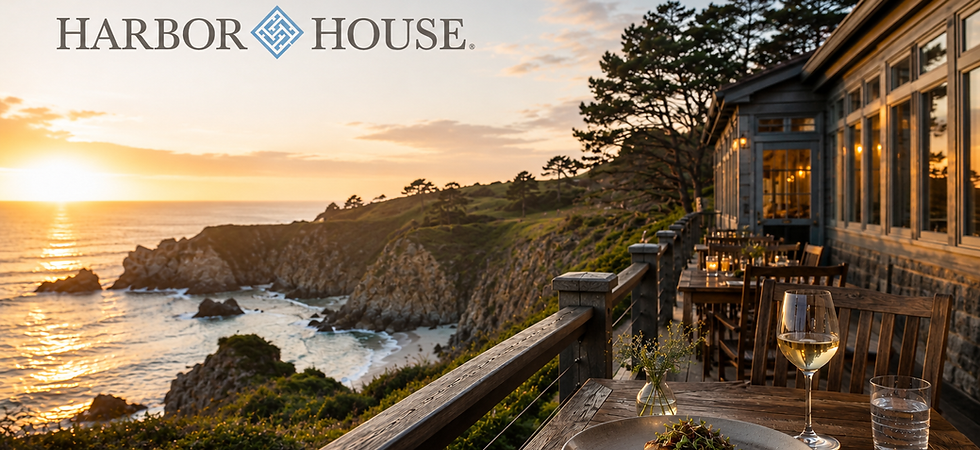
The Complete Guide to Harbor House Inn
Updated: Jul 7
Harbor House Inn is a two Michelin Star and Michelin Green Star destination on California's Mendocino Coast offering luxury accommodations, a hyper-seasonal tasting menu by Chef Matthew Kammerer, oceanfront lodging, and one of the country's most destination-worthy culinary experiences. There’s a stretch of Highway 1 on the Mendocino Coast where people usually go quiet without noticing it. The road tightens, the ocean opens up, and you start paying attention differently. Not because anything tells you to, but because everything around you feels a little sharper.
That’s often how guests describe their first approach to Harbor House Inn. It sits in Elk, a small coastal town that most people would miss if they weren’t looking for it. The building itself carries a long history dating back to 1916, but what it is today has been shaped more by its coastline than by its age.
Over time, the property became known for something very specific. A small, quiet inn paired with a Michelin-recognized restaurant led by Chef Matthew Kammerer. But even that description feels incomplete when you’re actually here. The dining, the rooms, and the surrounding coast all behave as if they belong to the same system rather than separate parts.
What Is Harbor House Inn?
Harbor House Inn is a historic coastal property in Elk on the Mendocino Coast. It combines a small inn with a Michelin-recognized restaurant shaped by seasonal coastal ingredients, foraging, and local sourcing. The experience is defined by its scale, its setting above a private cove, and its close relationship with the surrounding Pacific coastline.
We usually describe it less as a hotel and more as a place that operates at the pace of its environment. Nothing here is designed to feel interchangeable with anywhere else.
Key Takeaways
Located in Elk on the Mendocino Coast in Northern California
Historic inn established in 1916 with a modern coastal identity
Michelin-recognized dining guided by Chef Matthew Kammerer
Small-scale property with a limited number of guest rooms
Sustainability practices are built into daily operations, not added on
Where Is Harbor House Inn Located?
Discover Elk, California
Elk is small enough that people often pass it without realizing it. There’s a general store, a few turns off the highway, and then suddenly the coastline opens.
We’ve had guests tell us they drove past the entrance twice because nothing about it signals arrival. That’s usually the first adjustment. You’re not entering a resort zone. You’re stepping into a coastal town that still feels lived in.
This is part of what people later describe as a Northern California coastal getaway experience. It doesn’t announce itself.
Why the Mendocino Coast Feels Different
The Mendocino Coast travel guide version of this region talks about cliffs and redwoods, but what people tend to remember is how quickly everything changes here. Fog moves in without warning. Sunlight disappears and returns within the same afternoon.
We continue to see guests react less to specific landmarks and more to these shifts. One minute they’re walking the property in full light, and ten minutes later the ocean is gone behind a wall of fog.
Why is the Mendocino Coast a popular destination?
Because it combines forest, ocean, and rugged coastline within very short distances, creating a constant environmental contrast that changes throughout the day.
What Makes Harbor House Inn Different?
A Historic Building That Never Became Large
The building has existed since 1916, but it has never expanded into a large property. That decision, intentional or not, still defines everything.
Guests sometimes expect a luxury coastal inn California format with multiple wings or layered amenities. Instead, they find something contained. You learn the layout quickly because there isn’t much to learn.
An Intimate Scale That Shapes Behavior
There are only a small number of rooms. That changes how people move through the space.
We’ve noticed guests begin recognizing staff within hours. Conversations don’t need repetition.
Even small routines, like morning movement through the property, become familiar quickly.
The Private Cove Setting
The property sits above a private ocean cove along the Pacific. You don’t access it like a feature attraction. It’s just there, constantly in view or just out of it, depending on the weather.
What makes Harbor House Inn unique?
Its scale and its setting work together. The inn doesn’t feel placed on the coast. It feels integrated into it.
Why Is Harbor House Inn Michelin-Recognized?
Dining That Changes With the Coast
The restaurant is part of the reason the property is recognized as a Michelin-starred restaurant in California. But the recognition comes from process, not repetition.
Chef Matthew Kammerer builds the menu around what the coast offers at that moment. There isn’t a fixed version of what the dining experience “should” be across the year.
A Kitchen That Starts With Ingredients
We’ve had guests ask why they can’t revisit a specific dish they had years ago. The simple answer is that the ingredient itself changed or disappeared from that cycle.
That’s not treated as a limitation here. It’s the structure.
Coastal Cuisine in Practice
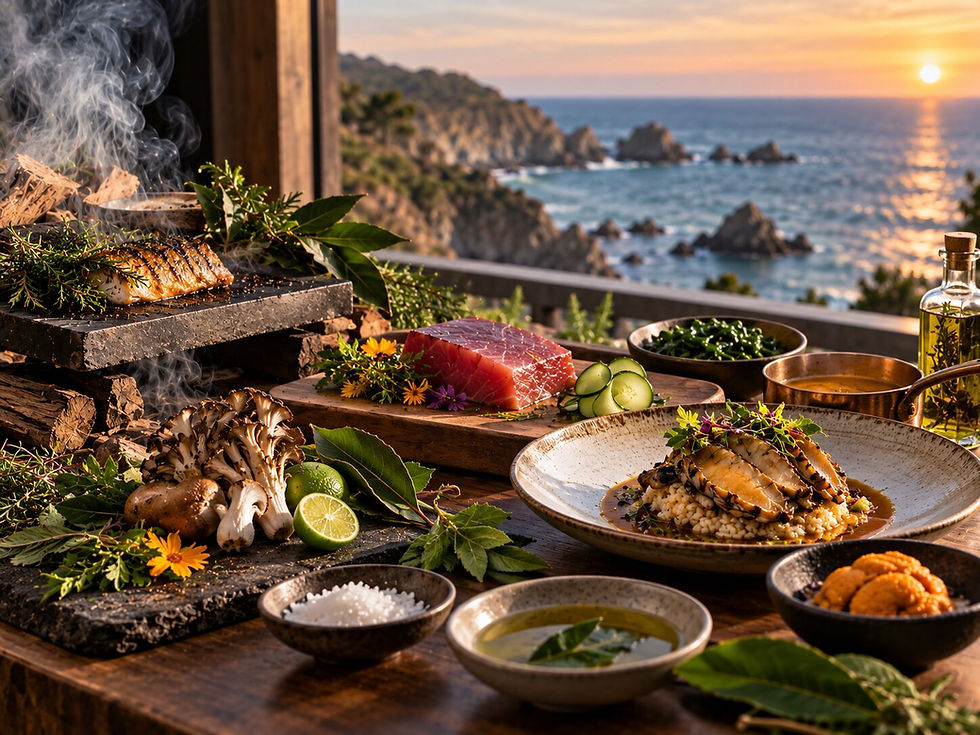
The coastal cuisine California identity here includes ocean products, forest ingredients, and inland sourcing. It’s not defined by seafood alone, even though the Pacific is always present in some way.
Why is Harbor House Inn Michelin-recognized?Because its dining program reflects a direct, changing relationship with the coastal environment rather than a fixed menu identity.
What Is the Harbor House Inn Tasting Menu Experience Like?
A Menu That Doesn’t Hold Still
The coastal tasting menu changes frequently based on availability and seasonal timing. Guests don’t experience a set sequence that remains stable across months.
Land and Sea in the Same Line
One thing we’ve noticed over the years is how often guests expect separation between land and ocean elements. Here, that line doesn’t really exist.
A single progression might move between forest-driven ingredients and ocean elements without framing it as contrast.
How Guests Respond
We often see guests stop trying to predict what comes next after the first few courses. Not because they’re disengaged, but because prediction stops working as a tool here.
They start focusing more on what’s in front of them rather than what might come later.
How Does Harbor House Inn Support Sustainability?
Michelin Green Star Recognition
The property holds recognition as a Michelin Green Star restaurant, which reflects operational practices connected to sustainability rather than a single initiative.
Renewable Energy Systems
Energy use is supported through partnerships, including Sonoma Clean Power, contributing to broader renewable energy hospitality practices.
Water and Waste Practices
Water is reused where possible for landscaping and gardens. Waste systems focus on reduction and reuse rather than disposal-first thinking.
Sourcing and Foraging
Ingredients are sourced through nearby producers and coastal foraging when appropriate, shaped by what the environment can support.
How sustainable is Harbor House Inn?
Sustainability is built into daily operations through energy, water, sourcing, and waste systems rather than being treated as a separate program.
How Does Chef Matthew Kammerer Shape the Experience?
Working With the Coast Directly
Chef Kammerer’s approach is shaped by the Mendocino coastline itself. The kitchen responds to what is available locally rather than building a fixed culinary identity.
Ingredients That Reflect Place
The Mendocino Michelin restaurant identity here comes from proximity. Ingredients reflect nearby ecosystems rather than global sourcing patterns.
Seasonal Decision Making
Menu decisions shift with conditions. Some ingredients appear briefly and don’t return for long periods.
Who is Chef Matthew Kammerer?
He is the chef leading Harbor House Inn’s coastal, seasonally driven culinary program shaped by the surrounding Mendocino Coast environment.
What Is Included in a Stay at Harbor House Inn?
Rooms at Harbor House Inn are limited in number, and that shapes the entire experience.
We’ve had guests arrive expecting a typical Mendocino Coast accommodations structure and then realize, within the first few hours, that everything operates at a slower, more contained rhythm.
The dining experience is part of the stay, but not separated from it. Movement through the property, the ocean views, and even simple amenities like EV charging and garden paths feel connected rather than segmented.
One thing we’ve learned over time is that guests rarely describe the stay by listing features. They describe moments. Light at a specific hour. Sound near the cove. A quiet breakfast before the coast fully wakes up.
Harbor House Inn vs Traditional Luxury Hotels
Aspect | Harbor House Inn | Traditional Luxury Hotels |
Scale | Very luxurious, intimate 11-room property offering a personalized guest experience | Larger properties with more rooms, amenities, and a broader range of guest services |
Dining | Seasonal coastal tasting menu | Fixed or rotating menus |
Location | Remote Mendocino Coast | Urban or resort areas |
Experience | Place-driven and quiet | Service-structured |
Rhythm | Environment-led | Schedule-led |
Who Should Stay at Harbor House Inn?
Couples often come for quiet time without structured plans. Food-focused travelers look closely at the dining program. Others come simply because they want a California coastal retreat that feels removed from standard travel formats.
We’ve noticed guests don’t always fall into one category. Some arrive for the cuisine and leave talking more about the coastline itself. Others come for the setting and end up focusing on the food more than expected.
Is Harbor House Inn worth visiting?
For travelers seeking a quiet, place-specific coastal stay with a strong culinary focus, it remains one of the most distinctive experiences on the Northern California coast.
Best Things to Do Near Harbor House Inn
Walk coastal trails near Elk
Explore Mendocino Village
Visit nearby redwood forests
Drive Highway 1 scenic stretches
Spend time at quiet local beaches
The region works best when you don’t try to structure it too tightly. Distances are short, but experiences feel spread out because of how the landscape shifts.
Conclusion
Harbor House Inn sits in a part of the California coast where the environment tends to set the pace first, and everything else adjusts around it.
The historic building, the small number of rooms, and the Michelin-recognized kitchen all function within that same rhythm. Nothing here feels isolated from the coast itself.
We’ve had guests leave and talk less about what they booked and more about small, unplanned moments. The sound of the wind near the cove. The way fog changed the view in a few minutes.
The feeling of a meal unfolding without a fixed expectation attached to it.
That’s usually what stays with people longer than anything else.
Frequently Asked Questions
What is Harbor House Inn?
A historic coastal inn with a Michelin-recognized restaurant in Elk, California.
Where is Harbor House Inn located?
On the Mendocino Coast in Northern California.
Does Harbor House Inn have Michelin recognition?
Yes, including Michelin Green Star recognition.
Who is Chef Matthew Kammerer?
The chef is leading the property’s seasonal coastal culinary program.
How many guest rooms does it have?
A small number, designed for an intimate experience.
What is included in the tasting menu?
A seasonal progression based on coastal and regional ingredients.
What makes it sustainable?
Energy systems, water reuse, sourcing practices, and waste reduction.
Is it worth visiting?
Yes, for guests seeking a quiet coastal stay with a strong culinary identity
How do Harbor House accommodations compare in terms of amenities and prices?
Each Harbor House accommodation offers unique amenities, views, and character, with rates varying by room type and season. Explore all room options and current pricing here: https://www.theharborhouseinn.com/accommodation



Comments