

Why Personalized Hospitality Is Becoming the New Luxury
Updated: Jul 22
At Harbor House Inn, we never set out to be a case study. Eleven rooms. A private cove. A kitchen that writes its menu each morning based on what the ranch and forest hand over. But that smallness turns out to be the point. Personalized hospitality is what guests now crave. Not gold taps. Not grand lobbies. They want to feel known. They want a personalized guest experience shaped around them, not a brand standard. This piece is about why that’s happening and how a quiet place like ours ended up in the middle of it.
Why Is Personalized Hospitality Important in Luxury Travel?
Personalized hospitality creates meaningful connections by tailoring every stay to individual preferences rather than following a standard experience. Modern luxury travelers increasingly value thoughtful service, authenticity, and genuine attention over traditional displays of extravagance.
What Is Personalized Hospitality?
Personalized hospitality is treating guests like individuals. Not booking numbers. It means remembering a face, a preference, a story. Anticipating what someone needs before they ask. It’s the difference between a flawless but scripted check-in and someone handing you a cup of tea, knowing you prefer it to coffee because you mentioned that in an email months ago.
Traditional luxury hospitality service can be impressive but hollow. Polished phrases, rigid protocols. That works if you want efficiency. Personalized hospitality is warmer. Looser. More human. It notices the small things. A guest who lingers over the view. A couple celebrating quietly. It adjusts the pace of a meal, the timing of a fire being lit, and the recommendation for a walk that matches their mood. Customized experiences are part of it, but personalization runs deeper. Customization might offer a choice between two activities. Personalization is noticing the guest doesn’t want any activity at all. They just want to sit.
Why has this become one of the biggest trends? Travelers are tired of being processed. They want to be seen. When you stay at a place with only eleven rooms, that happens naturally. There’s no front desk queue. No assembly line. The team learns who you are because there aren’t hundreds of you. That intimacy is the new personalized luxury.
Why Luxury Travelers Are Seeking More Meaningful Experiences
Material luxury has been losing its shine for years. We’ve watched it. Guests used to ask about square footage and the thread count. Now they ask about the sound of the waves. Whether they can walk the tidepools at dawn. They’re chasing meaning, not stuff.
Slow travel is a big part of this. People stay longer. They don’t rush a checklist. They want to settle in, learn the rhythm of a place, and feel like they belong for a few days. Wellness travel overlaps. Not just spas. The kind of restoration that comes from deep sleep, silence, and food that nourishes. We see guests arrive wound tight, and after a night of hearing nothing but the foghorn, they look different at breakfast. Lighter.
Authenticity matters more than ever. Travelers can smell a performance. They don’t want a staged version of a coast. They want the real one. Fog, wind, cold water, all of it. Privacy is another huge factor. Big resorts can feel like airports. Here, the cove is private. No public path. Guests often have it to themselves. That seclusion is a luxury no amenity can match.
Smaller boutique hospitality properties are booming because they offer what the big ones can’t. A sense of place. A slower heartbeat. A feeling of being welcomed into a home rather than processed through a lobby. That’s the shift. From collecting things to collecting moments and luxury travel experiences.
Personalized Hospitality Begins with Place
Location isn’t a backdrop. It’s the foundation. The Mendocino Coast shapes everything here. You feel it the second you step out of the car. Salt air. The boom of waves. Fog hangs over the redwoods. That environment does half the work of personalizing a stay because it’s so distinct.
Our building has stood since 1916. Not a new build trying to fake character. The redwood paneling, the stone fireplace, the windows that frame the Pacific. It all holds a century of quiet. There are only eleven rooms. The Pacific fills the view. Below the inn, a private cove. Guests walk down a winding path and find themselves alone with the tidepools. No tour buses. No strangers.
Redwood forests stretch behind the property. Walking paths wind through ancient trees. The gardens are planted with herbs the kitchen uses and flowers for bees. No guided tours. You just wander. The calm is deliberate. There’s no bar, no pool deck, no lobby buzz. The loudest sound is the wind or the foghorn. That environment lets each guest find their own experience. One might sit in the cove for hours. Another might walk the forest and return softer. The place gives what they need. That’s the beginning of personalized luxury. A setting that feels like it’s yours.
Personalized Hospitality Through Culinary Experiences
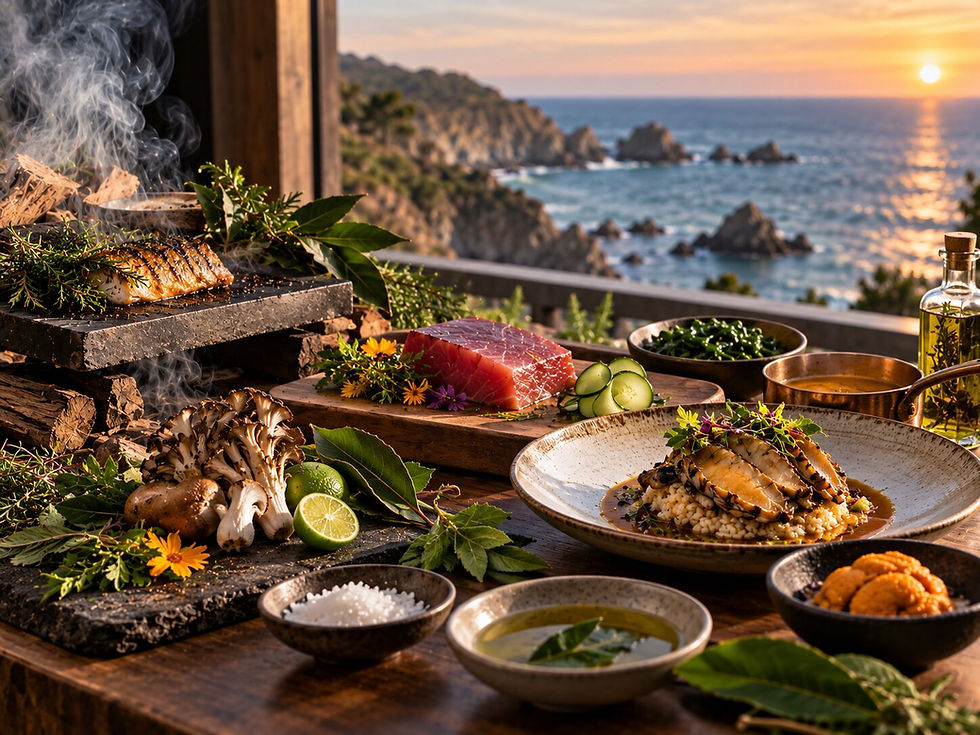
The kitchen, led by Chef Matthew Kammerer, is an extension of the same philosophy. The food isn’t designed to show off. It’s designed to reflect the Mendocino Coast on that specific day.
His approach is hyper-local. Ingredients come from our own ranch, from the forest, from the tidepools directly below the inn. The menu changes with what’s available. A dish that appears in June is gone by July because the ingredient has finished its season. That means every meal is a one-time event. You can’t order the same thing twice. You can’t return a month later and expect the same menu. The kitchen writes a new one each morning after Chef Matthew Kammerer walks the garden and talks to the foragers.
This creates a deeply Personalized Guest Experience. When a server explains that the mushrooms were foraged that morning, or that the seaweed came from the cove at low tide, the food becomes a story. Guests taste the landscape. The hospitality isn’t just service at the table. It’s letting the coast write the meal. You’re not a diner. You’re part of a moment in the life of this place. That’s Personalized Luxury on a plate and a true Michelin Dining Experience.
How Does Sustainability Enhance Personalized Luxury Hospitality?
Sustainability strengthens personalized luxury by creating experiences that feel authentic, responsible, and deeply connected to the destination. Guests can enjoy exceptional hospitality while knowing their stay supports thoughtful environmental practices.
Sustainability Enhances Personalized Luxury
Sustainability here isn’t a brochure. It’s daily practice, and it makes the Luxury Guest Experience richer in quiet ways.
The inn runs on 100% renewable energy from local sources. Our ranch supplies much of the kitchen’s produce. The vegetables on your plate were likely harvested that morning from soil you can walk to. We filter our own water and serve it in glass bottles. Single-use plastics are rare. These aren’t greenwashing. They’re just how we operate, and guests feel it. The environment feels cleaner, more honest.
Chef Matthew Kammerer’s kitchen wastes almost nothing. Trimmings become stocks. Shells become compost. The ranch is a closed loop. We also participate in purple sea urchin removal. Urchins have decimated kelp forests. Removing them helps the ecosystem and gives the kitchen a unique ingredient. It’s a small act with real impact. The Michelin Green Star recognized this commitment. But we did it long before the star existed.
For guests, this adds meaning. Knowing the inn treads lightly on the land they’re enjoying aligns with their values. It’s not a lecture. It’s just visible. That integrity deepens the experience. It makes the Luxury Hospitality feel more personal, more earned, while supporting Sustainable Luxury Hospitality.
Luxury Hospitality and Service
The focus has shifted to how a guest feels, not just what they’re given.
Key elements include Personalized Hotel Service, where needs are anticipated without asking. Attention to detail that creates a seamless stay. Exclusivity and privacy through Intimate Accommodations. Design that weaves architecture, nature, and a strong sense of place together. And experiential value, creating memories rather than material luxury.
At Harbor House Inn, these aren’t buzzwords. It’s just Monday. Personalized Hotel Service happens because we have eleven rooms and a team that remembers. Attention to detail shows up in small things: a fireplace lit before dinner, the right chair waiting in the library. Exclusivity and privacy are inherent to the cove, the garden, and the dining room spacing. The design is the 1916 building, restored, surrounded by Pacific views and redwoods. And experiential value? That’s the whole point. A meal that tastes like this coast. A sleep so deep it resets you. A stay that feels less like a hotel visit and more like belonging to a place for a little while. That’s Luxury Hospitality now. Not a checklist. A feeling.
Why Boutique Hospitality Is Reshaping Luxury Hospitality
Small properties aren’t a niche anymore. They’re leading the conversation.
Personalized hospitality is impossible at scale. A 300-room hotel cannot know every guest. An 11-room inn can. Our team remembers faces, stories, preferences. That builds a relationship, not a transaction. Thoughtful design matters more than size. Our rooms aren’t huge. But they face the sea. The furniture is hand-built. The fireplace is real. Those details feel more luxurious than a cavernous suite with generic decor. That level of care creates a true Luxury Guest Experience.
Why Are Boutique Luxury Hotels Better for Personalized Hospitality?
Boutique luxury hotels can provide more attentive service because their smaller size allows teams to build genuine relationships with guests. This creates a more intimate, memorable, and highly personalized luxury experience.
Harbor House Inn as a Modern Example of Personalized Hospitality
We don’t claim to be the blueprint. We just happen to be built in a way that aligns with what people now value.
Historic character gives the inn weight. The 1916 bones, the original redwood, the stone hearth. Personalized Hospitality flows from the small scale. Eleven rooms, real attention, no scripts. The Michelin-recognized dining, Two Michelin Stars and a Michelin Green Star, shows that world-class food can be intimate, not formal. Together with Chef Matthew Kammerer, our approach reflects Quiet Luxury Hospitality, Luxury Hospitality, and a deeply Personalized Guest Experience.
Final Thoughts
Sustainability is practice, not marketing. Renewable energy, the ranch, water filtration, conservation. It all supports a Luxury Guest Experience that feels genuine while reflecting Sustainable Luxury Hospitality.
Sense of place is the thread. The Mendocino Coast is in everything. The view, the air, the ingredients, the silence. When these elements combine, guests don’t just enjoy a stay in our Luxury Accommodations. They feel connected. That’s Personalized Luxury. Not excess. Meaning.
Frequently Asked Questions
What is Personalized Hospitality?
Treating guests as individuals, anticipating needs, remembering preferences, and shaping the experience around the person rather than a script.
Why is Personalized Hospitality becoming the new luxury?
Travelers are moving from material opulence to experiences that feel intimate, meaningful, and emotionally resonant. Being known matters more than being impressed.
How does Personalized Hospitality differ from traditional Luxury Hospitality?
Traditional Luxury Hospitality can be flawless but cold. Personalized Hospitality is warmer, flexible, and rooted in human connection rather than rigid protocols.
Why do travelers prefer Boutique Luxury Hotels for personalized experiences?
Smaller properties offer individual attention, intimate atmospheres, and a sense of belonging that large resorts can’t replicate.
What role does sustainability play in Luxury Hospitality?
Sustainable Luxury Hospitality, when genuine, adds depth and integrity to the guest experience, aligning with the values of travelers who care about the environment.
How does Harbor House Inn create Personalized Guest Experiences?
Through eleven rooms, a private cove, a chef’s daily menu from the ranch and surroundings, and a team that pays attention to the details that matter to each guest.
What makes Harbor House Inn different from larger luxury hotels?
Intimacy, deep connection to the Mendocino Coast, historic architecture, and a Michelin Dining Experience that changes with the seasons. It’s a place, not a product.
How does Michelin-recognized dining enhance Personalized Hospitality?
When a menu is shaped by what’s available that day, each meal is unique. Guests experience something unrepeatable and deeply tied to the location.
What is Quiet Luxury Hospitality?
Quiet Luxury Hospitality emphasizes authenticity, privacy, craftsmanship, and a sense of place over visible extravagance. It values what is genuine over what is loud.
Why are travelers seeking authentic Luxury Travel Experiences?
They’re weary of performance and excess. They want real landscapes, real flavors, and moments of calm that restore rather than overstimulate through Personalized Travel.



This is a thoughtful way to frame modern luxury. The most memorable service is often not extravagant; it simply removes friction and gives guests more time to experience the destination. A good example is Washbliss, which lets travelers arrange laundry pickup and delivery in Da Nang without planning their day around a laundromat. Small, practical touches like that are what make hospitality feel personal rather than standardized.